

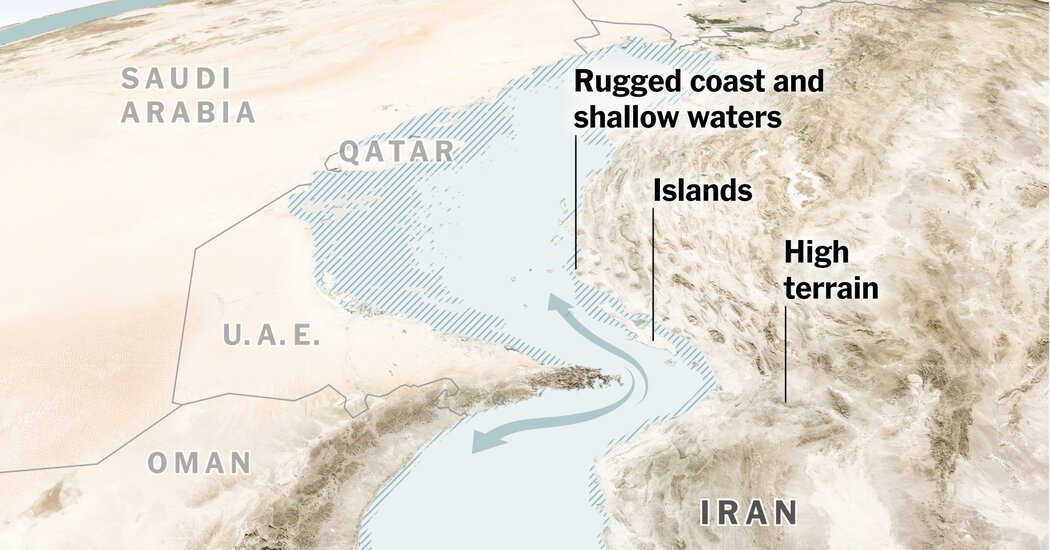
Hundreds of oil tankers are idling at either end of the Strait of Hormuz. Iran, responding to attacks by the United States and Israel, has effectively blockaded it.
As soaring oil prices rattle the global economy, President Trump has vowed to reopen the shipping route “one way or another.” But short of a deal with Iran or a dangerous, prolonged occupation, experts warn, it will be hard to fully restore traffic in the strait.
Here’s why.
Geography is strategy
The strait is narrow and shallow, forcing ships within miles of Iran’s mountainous shores, a landscape that favors asymmetric warfare tactics, in which Iran uses weapons that are small, widely dispersed and hard for adversaries to eliminate completely.
“The Iranians have thought a lot about how to utilize the geography to their benefit,” said Caitlin Talmadge, a professor at the Massachusetts Institute of Technology who studies Gulf security issues.
The weapons may be relatively small, but that allows the Iranians to hide them in cliffs, caves and tunnels, and then deploy them at close range along the coastline.
“The sheer proximity of Iran and width of the strait is what makes it so difficult,” said Jennifer Parker, a former naval officer now at the National Security College of Australian National University.
A vessel that comes under attack in the waterway doesn’t have much time to act.
“You have very limited time from a detection,” Ms. Parker said. “To then try and respond and take out that missile or drone, your response time, depending on the speed of it, could well be minutes.”
Hidden firepower
Mr. Trump has sent mixed messages about how he hopes to reopen the strait, including suggesting on Monday that he could jointly control the strait with Iran’s supreme leader. But most of the options the United States is considering involve the military.
The first step toward opening the strait by military force would involve trying to strip away Iran’s ability to attack ships. Since the war began at the end of February, as many as 17 vessels have been struck, according to Kpler, a maritime data firm.
So far, thousands of U.S. and Israeli attacks on Iranian military sites have not managed to stop the threat. It may not be possible to find and destroy every last place where Iran’s weapons are being stored, or deployed.
“They have many places where they could put missile batteries,” said Mark F. Cancian, a senior adviser at the Center for Strategic and International Studies and a retired Marine Corps colonel. “And because the missile batteries are mobile, it’s hard to find and target them.”
Mr. Trump has called for naval escorts for commercial tankers transiting the strait. That, Mr. Cancian said, would be a major military operation.
“It would involve ships escorting the tankers,” he said. “There would be minesweepers to take care of any mines that might have been laid. There would be aircraft overhead to intercept any drones and to attack any missile batteries on shore.”
Sending in warships to fend off drone and missile attacks brings its own risks.
“The destroyer’s defensive systems are really designed for something different than the close-in knife fight of the strait,” said Eugene Gholz, an associate professor of political science at the University of Notre Dame. “Every part of the destroyer is sensitive to being attacked.”
But it may be mines that are the biggest threat.
“If there’s a seriously credible threat of mines being in the water, that changes things completely,” said Jonathan Schroden, an expert on irregular warfare at CNA, a nonpartisan defense research institute. “No navy is going to want to put their capital ships in a waterway that is potentially or actually mined.”
Mine-clearing operations could take weeks, and they could put U.S. sailors directly in harm’s way. The slow-moving teams would require protection themselves, including air cover.
Risks on the ground
Marines are streaming toward the region, and experts say the Pentagon might use them to pursue ground operations to launch raids or set up air defense systems for the convoys.
Given the size of Iran’s own ground forces, the Marines may limit their incursions to islands in the strait and avoid trying to take territory on the Iranian mainland, experts say.
Even then, the risk of American losses may lead Mr. Trump to shy away from that option.
“If the ground forces are killed or captured, it changes the dynamics completely,” said Ms. Parker, the former naval officer.
The limits of success
Even with a major military operation, all it takes is one strike to set back confidence again.
Right now, most tanker operators are not risking a passage through the strait. There are nearly 500 tankers in the Persian Gulf, west of the strait, and most of them are not moving, according to S&P Global Market Intelligence.
To get those vessels delivering oil again, ship owners and the companies that insure the vessels would have to be convinced that escorts would provide sufficient protection.
Even with companies on board and a large defensive convoy operation underway, military escorts can only provide protection for a few ships at a time. In February, before the war, around 80 oil and gas tankers were going through the Strait of Hormuz a day.
“The important thing is to reassure the shipping companies and insurance markets that the risk is low enough for them to make it worthwhile to go through the strait,” said Kevin Rowlands, a naval expert at the Royal United Services Institute, a research group in London.
A large sophisticated escort effort could also be a drain on U.S. military forces. Escort convoys could divert valuable military units away from the U.S.-Israeli air campaign and from protecting other forces in the region.
And because Iran has struck ships in both the Persian Gulf and the Gulf of Oman, vessels would still need protection after transiting the strait, a longer endeavor for military assets.
“I think as long as there is a residual Iranian threat to the strait, you will see an effect on traffic,” said Ms. Talmadge. “For things to truly return to normal, it will require a diplomatic and political solution.”
