

In January, at the peak of the violent crackdown on widespread anti-regime protests in Iran, a medical worker in the northern city of Rasht suddenly found his trauma center overwhelmed with hundreds of injured protesters.
Many were struck by multiple pellets or bullets targeting their heads, necks, chests, femurs and abdomens. “They were shooting to kill, absolutely,” he said.
After four days, he finally went home. Instead of sleeping, he began compiling 11 gigabytes of X-rays, CT scans and medical records, later sending them to us on an encrypted messaging app.
“They want to sweep it under the rug,” he wrote.
It is difficult to independently verify exactly how many protesters were killed by Iranian security forces. The Washington-based Human Rights Activists News Agency, which tallies only victims it can identify, has reported at least 6,800 protest-related deaths, with an additional 11,744 cases under investigation.
Other estimates put the death toll much higher. The former United Nations war crimes prosecutor Payam Akhavan believes it could be in the tens of thousands, based on reports by a network of doctors in Iran collecting hospital records as well as the scale and geographic spread of the killings.
“This is not just the worst mass killing in the contemporary history of Iran,” said Mr. Akhavan, now a human rights lawyer and a co-founder of the Iran Human Rights Documentation Center. “It is one of the worst mass killings in contemporary world history.”
Iranian officials have said that 3,117 people died in the protests and claimed that those killed were civilians, security personnel and “terrorists.” On Jan. 8, the authorities plunged the country into a near-total internet and phone blackout, which lasted for weeks, obscuring the scale of the crackdown.
They also tried to silence those who are uniquely positioned to describe the magnitude of the carnage and share the stories of the injured and the dead: Iran’s frontline medical workers.
In the days following the bloodshed, which reached its height on Jan. 8 and 9, we contacted dozens of doctors and nurses working in Iran, many of whom had also begun to quietly document what they saw as they attempted to provide aid to demonstrators.
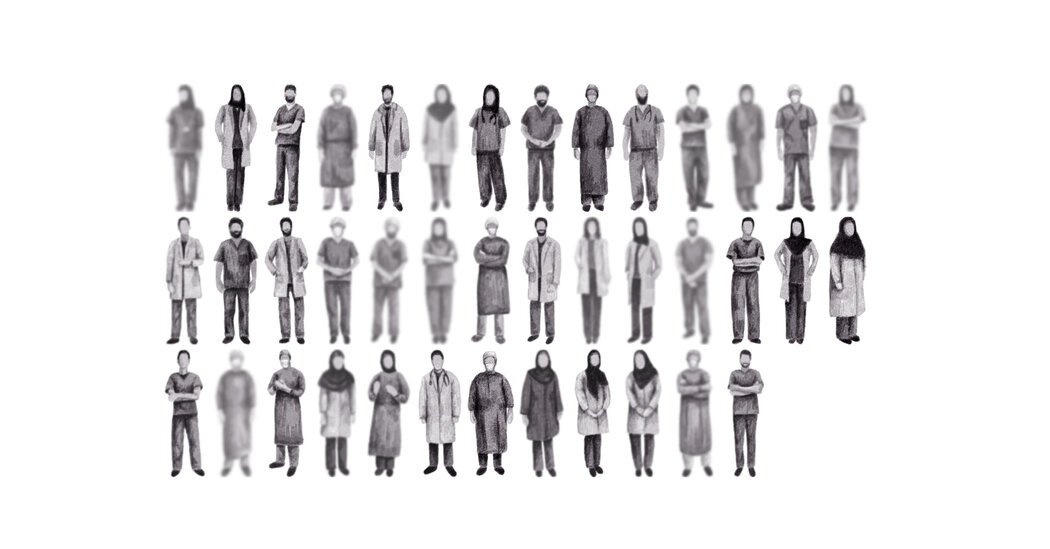
Working with Times Opinion and relying on our contacts in the Iranian diaspora and inside the country, we surveyed 40 Iranian doctors and nurses across 14 cities and 11 provinces about their experiences treating wounded protesters. They shared their stories with us at great personal risk. Their identities were verified by Times Opinion and are being withheld to protect them from retaliation.
This is what they told us.
All 40 doctors and nurses said they were shocked by the severity of the injuries to the wounded Iranian protesters.
A range of medical providers participated in the survey, including trauma surgeons, anesthesiologists, orthopedists, nurses and emergency physicians. They messaged us from Gilan Province, on the coast of the Caspian Sea, Hormozgan Province on the Persian Gulf, and from smaller cities and large urban centers, such as Tehran and Isfahan.
The images and testimonies we received match accounts from witnesses and human rights groups of a sharp escalation in the authorities’ use of force to lethal tactics, including live ammunition and military-grade weapons, on the evening of Jan. 8.
They add to a growing body of evidence that the Iranian regime’s slaughter of unarmed protesters last month was not lawful policing of political unrest. It was a massacre, and it should be treated as such.
Representatives of the Iranian government did not respond to requests for comment.
All 40 doctors and nurses said they saw injuries indicative of deliberate killings or the intent to inflict serious bodily harm.
Many of the accounts we received from the doctors and nurses inside Iran were of children under 18 who were injured or killed. The youngest was a newborn.
“A breastfeeding mother was holding her baby when security forces opened fire on their car,” a doctor from South Tehran told us. “They arrived at the hospital in that same vehicle, riddled with bullets. The bullet passed through the baby’s hand and into the mother’s chest.”
A nurse from the central city of Isfahan sent us testimony from one boy’s father, who described his desperate attempts to save his teenage son’s life:
“We had gone to the streets to protest. The officers attacked my son, targeting his head and neck with a pellet gun. I begged the riot police to stop. But before my own eyes, they fired the final shot — a live bullet — into his head.”
The boy died soon after arriving at the hospital. “We buried him as security forces stood watch,” his mother said. She described him as “a calm, social and well-mannered boy” who loved soccer. She added that she wants him “to be remembered as a hero, brave, with a pure and kind heart, and full of love for life.”
At least 209 children were killed in the protests, according to Shiva Amelirad, who represents a network of teachers’ unions inside Iran that is looking into the deaths. She said that number is a conservative estimate based on medical evidence and confirmation from victims’ relatives, teachers and others, and that the group is investigating more cases.
“There is a consistent pattern in many documented cases indicating that children were shot in the head,” Ms. Amelirad said.
Twenty-three said they saw preteen children who had been seriously injured or killed, and 36 said they saw multiple cases of injured or killed teenagers.
Three did not see either.
Many of the doctors and nurses told us they went to great lengths to prevent the Iranian authorities from identifying their patients as protesters — for example, by falsifying their medical records, erasing security camera footage or treating them in private homes. They were worried their patients could be abducted or even killed.
Doing so put the medical workers themselves in danger. Many reported that they or their co-workers had been threatened, interrogated or summoned to appear before the authorities. Several said they had colleagues who had been detained.
Homa Fathi, a member of the International Independent Physicians and Healthcare Providers Association, a U.S.-based nonprofit that advocates health and human rights in Iran, told us that dozens of health care providers in Iran are now incarcerated. “Health care workers in Iran have been killed, arrested and tortured,” she said. “Many of them are facing harsh trials, prison sentences and a ban on their license just because they tried to help the injured.”
One of the doctors in Tehran who participated in our survey had previously spoken out publicly about regime pressure on medical staff members. He told us that security agents had warned him that if he didn’t keep quiet, they would send him “to the cemetery.”
A few days later, one of the doctor’s family members told us he had been arrested.
Thirty doctors and nurses witnessed or experienced pressure to restrict or deny medical care to wounded protesters.
Eight did not. Two left the question blank.
Several doctors we contacted said they were too haunted by what they had seen to take part in our survey. Among those who did respond, many reported experiencing extreme distress, including nightmares, flashbacks, grief, anger and anxiety. A few said they had become suicidal.
Many have concluded that they have little choice but to ask the outside world to protect them, along with their patients and other Iranians calling for basic freedoms. They pleaded for international help to ensure such atrocities don’t happen again.
The doctors and nurses reflected on their experiences treating wounded demonstrators.
So far, the international community has done little to put a cost on these crimes. When discussing regime change in Iran earlier this month, President Trump said, “It seems like that would be the best thing that could happen.” He has amassed U.S. forces in the region, raising the possibility of military action. Mr. Trump had also warned the Iranian authorities not to kill peaceful protesters, emboldening many to march.
But for now, the White House is still negotiating with Iran’s leaders over their nuclear program as if these atrocities had never happened, leaving many Iranians, including several of the medical providers we spoke with, feeling betrayed.
“This regime must end, and the blood of so many young people must not be trampled,” a surgical nurse in Isfahan wrote in response to our survey. “The world must not reach agreements with this regime and must help the people of Iran overthrow it.”
What we heard repeatedly was a deep fear that the regime would go unpunished. One doctor in Tehran cautioned that without accountability, “any dictator could rise and kill as many as it takes to keep control.”
Accountability could mean choking off the Iranian regime’s oil revenues, primarily from sales to China, which are used to bankroll repression. It could include asset freezes and the expulsion of Iran’s ambassadors. The European Union last month followed the United States in designating Iran’s Islamic Revolutionary Guard Corps as a terrorist organization, and other countries should do the same.
International bodies, like the fact-finding mission on Iran established by the U.N., should secure and preserve survivor accounts and medical evidence so they can be used to support human rights prosecutions under international law. And they should press for the protection of Iranian medical workers and safe access to health care for their patients.
Nearly 54,000 Iranian demonstrators have been arrested, according to the Human Rights Activists News Agency. Detainees are often held in overcrowded and unsanitary conditions, without access to lawyers, and are threatened with torture. Dozens of detained protesters face charges that can carry the death penalty. Karen Kramer, the deputy director of the Center for Human Rights in Iran, said she is “extraordinarily worried” that protesters held in unofficial “black box” sites are at grave risk of physical and sexual abuse and death because “state agents are able to act completely under the radar.” Governments should increase pressure on Iran to immediately release detained demonstrators and medical providers and to stop any further deaths in state custody.
“If this regime remains, the true number of those killed will become many times higher,” the surgical nurse in Isfahan wrote. “Every night I fall asleep hoping for the freedom of my Iran.”
These doctors and nurses chose to speak out about what they saw in their hospitals and emergency rooms over the safety of silence. They are asking the world not to look away.
You can learn more about how we gathered reports from Iran’s medical workers in a video, here.
