

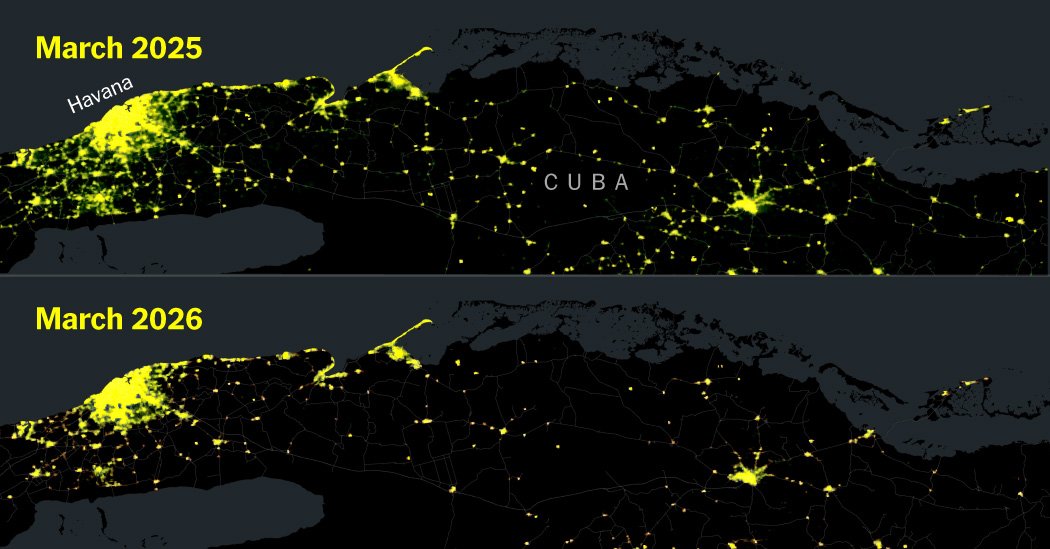
Cuba is facing what may be its worst electricity crisis since Fidel Castro’s revolutionaries swept to power 67 years ago. Following weeks of frequent blackouts, the national grid suffered a “complete disconnection” on Monday, according to the energy ministry.
Blackouts are getting worse, and on some days the entire island is plunged into near total darkness.
Cuba generates most of its electricity from oil, and for nearly three decades, Venezuelan oil has been the island nation’s energy lifeline.
The Trump administration ordered Venezuela to halt supplying oil to Cuba after it captured the country’s president, Nicolás Maduro, in January. Mexico was soon pressured by the U.S. to stop shipments as well. No other country has come to Cuba’s rescue with oil supplies.
U.S. officials are now using the energy crisis to exert leverage over Cuba’s leaders, even as some in Cuba warn that the repeated blackouts could make it harder for Cubans to get food, running water and medical care.
Cuba’s president, Miguel Díaz-Canel, has publicly acknowledged this month that his government has been holding talks with Washington in an effort to find solutions to Cuba’s standoff with the United States.
Mounting Crisis in the Capital
The capital, Havana, is usually a priority in electricity generation because it is the seat of government. But as the energy crisis grows, it is also not shielded from going dark.
The whole city is feeling the ripple effects.
Trash is piling up as garbage trucks are idled due to a lack of fuel. Without refrigeration, meat and dairy in homes and food markets are spoiling.
Because Havana’s water system depends on electric pumps, running water has been cut off for many residents, who now line up with jugs at gravity-fed community cisterns, according to Jorge R. Piñon, a University of Texas oil expert who tracks Cuba’s energy industry. Public health officials have postponed tens of thousands of surgeries, and cancer patients undergoing chemotherapy have seen their treatments disrupted by power outages and a lack of refrigerated medicine.
The “Luxury Bubbles”
Lights largely remain on in resort areas like Varadero, Cayo Coco and Cayo Santa Maria, home to strings of beach hotels and spa complexes. Unlike residential areas that depend on the failing national grid, hotels in these places have their own generators, and fuel for these locations is a top priority, alongside hospitals.
That’s because tourism remains a crucial source of hard currency for Cuba’s government, even after some airlines suspended flights to Cuba because of a shortage of jet fuel at major airports caused by the U.S. blockade.
The energy crisis has created a bizarre reality in these areas.
They are some of the primary beneficiaries of recent efforts to create a decentralized network of small solar arrays using Chinese technology. That means workers at these resorts commute from places with little electricity, a lack of running water and rotting food to “luxury bubbles” where tourists enjoy air-conditioned rooms and refrigerated buffets. Military checkpoints strictly control access to these locations.
Unrest Flares Up in the Provinces
The rest of Cuba, far from the seat of power and the beach resorts, is hit hardest by the crisis.
After weeks of blackouts, hundreds of people in Morón, a city of 70,000 in central Cuba, took to the streets. On March 13, they ransacked the local office of the Communist Party, dragging furniture, computers and documents into the street to set them on fire.
In eastern Cuba, the provincial electricity company for the city of Holguín is providing electricity for residential neighborhoods for only about three hours a day. Major economic drivers, like nickel processing plants, have had to scale back operations, cutting the country’s exports.
Santiago, Cuba’s second-largest city, is suffering from severe disruptions to both electricity and running water. People there have started nighttime protests known as cacerolazos, in which they bang on pots and pans to express their anger.
An Outdated Energy System
For Cuba, the crisis has laid bare the risks of depending so heavily on foreign oil while trying to maintain a centrally planned socialist economic system.
While countries around the world are using diverse methods to produce electricity, such as natural gas, wind or battery storage, Cuba is still locked into a 20th-century model exceptionally dependent on oil. That makes the island nation extremely vulnerable to oil shocks.
The last confirmed arrival of a significant oil tanker was the Ocean Mariner, which docked in Havana on Jan. 9 with about 86,000 barrels of fuel from Mexico. Since then, Cuba has had to rely on its own meager production of extra-heavy crude oil, which covers only about 40 percent of energy demand.
That shortfall could bring Cuba’s whole economic system, not just its electricity grid, to the breaking point.
About the data
The nighttime lights analysis compares light intensity in Cuba from March 6 to 12, 2026, with the same period in 2025, using satellite imagery. The light intensity shown is the average of the seven-day period based on available data. There may be small gaps in the data where the satellite did not capture coverage. These gaps tend to occur in areas that were dimly lit in previous years.
