

After two years of war, I keep telling
myself, “This is not Gaza.”
The details are all wrong.
Nothing is the same.
People usually feel nostalgic for their homeland when they are far away. I feel a deep nostalgia for Gaza, even while I am still here. It’s not the kind of longing that comes from distance. It’s because I’m surrounded by what should feel familiar but everything feels uncanny, changed, almost unrecognizable and distorted.
I keep telling myself, “This is not Gaza.” The details are all wrong; nothing is the same. My nostalgia is not for a distant memory but for the very ground beneath my feet, for a Gaza that seems to have slipped away from me even as I live within its borders.
One morning last month I tiptoed out of my home in Deir al-Balah to get some fresh air. Our two-bedroom apartment is crowded — three families have been living here for the past year. Sixteen more family members arrived fleeing from shelling in recent weeks. I was careful not to wake my relatives, some of whom had arrived at night and spread out into every corner of the house.
Outside, the street was buried under tents: tents on the sidewalk, tents in the alley, swallowing up the medians and sometimes even the road itself. There are tents in the agricultural lands; some appear between the remaining date palm trees my city is named after. Hundreds of these trees surrounded our town before the war. A lot of them have burned down or been bulldozed by Israeli tanks.
Some people hadn’t pitched their tents yet. They had come from Gaza City, where the Israeli military is conducting a brutal assault, and arrived in the dark, deciding to wait for daylight to figure out where to put their tents — to figure out their lives. I despise this word: “kheima” in Arabic, “tent” in English. It has followed Palestinians for generations, like a shadow.
I still live in my house, though it is no longer a home. It has been hit with Israeli tank shells more times than I can count; four of those times we were inside. The “walls” are half the height of what they used to be, rebuilt with stone taken from the ruins of other people’s homes. I joke that one blue block came from that neighbor; my brother answers that an orange one came from another, whose home is now demolished. The stones stop short of the ceiling, so every whisper travels everywhere. There are no windows, only nylon fabric we recently stretched across the gaps for winter. No doors, just blankets.
I don’t know how this war appears to others. Living in Gaza, it’s a war of details. I think back to my first creative writing class, when the instructor told us: “Show, don’t tell. ‘God is in the details.’” I loved that rule. But the details of war are strange, and they are painful.
The details of my home — the blue and orange stones, the collapsed walls — make me feel guilty, but also grateful, because I have not yet been forced into a tent. That is what this war teaches us: Even suffering has a hierarchy, and even survival has a rank. A room with walls is better than a tent; a proper aid tent is better than a patchwork one stitched together from blankets, nylon, old jeans and empty flour sacks. A tent is better than nothing at all.
At the grocery store, I ran into one of my old teachers. She reminded me of two of my classmates who were killed in Israeli strikes. “Those kind girls are gone,” she said. Then she asked where I live now. “At home,” I told her, “though it’s destroyed.” She nodded. “Still better than a tent on the rubble.” The hierarchy determines how we speak, what we share and how we live with one another. I want people outside Gaza to understand these details.
A few weeks ago shells slammed into our building in the middle of the night. We woke to the thunderous sound of explosion. The rooms became heavy with debris and dust. My mind tried to bargain with itself: Where are we? What is this? For a second, it insisted: This isn’t war. I wanted to believe the lie.
Then I jumped. The darkness was suffocating, too thick to see, too thick to breathe. I found a flashlight and swept a path so my mother — who fell and fractured her hip last year — could be moved with her walker.
We stepped outside, counting faces and asking if everyone was OK. But there was no respite. Israeli drones and quadcopters hovered above, their engines buzzing like mechanical insects. The sky glowed with their lights through the dark night. We were afraid to stay outside. After a while, we went back in and cleaned until dawn, and then we cleaned again.
Two years of war have also created a hierarchy of feelings — a hierarchy of loss. We were lucky; only my sister-in-law’s nose was nicked. The next day I saw a friend who lost 47 members of his family from airstrikes in the first two months of the war — his parents before his eyes, four brothers, nephews and cousins. Gone. I kept quiet. What could I say to him? That a shell tore through my house and we all survived? How do you speak of cracked walls to someone who counts absent faces? My loss is walls; his is people. Survival can feel like a debt you can’t repay.
At night I rehearse the scenes of different airstrikes I’ve lived through and wonder: What if a shard from the missile blast had found me, taken my legs? Sometimes I tell myself it might be kinder to die whole than to live in pieces. Gaza feels like a city of amputees now. Almost every time I step outside, I meet another. Yesterday it was a man in a wheelchair set on a donkey cart.
Another day, at Shuhada al-Aqsa Hospital in Deir al-Balah, I was filming and helping coordinate a photography assignment when a cardboard box slid out from behind the doors of the surgery ward. A name was written on the top. “Give it to the family,” a doctor told a cleaner, her face masked and her black veil tucked into her brown gown. I only realized what was inside when a woman took it into both of her arms. It was a leg that had just been amputated. Eight months later, I still remember the name on that box.
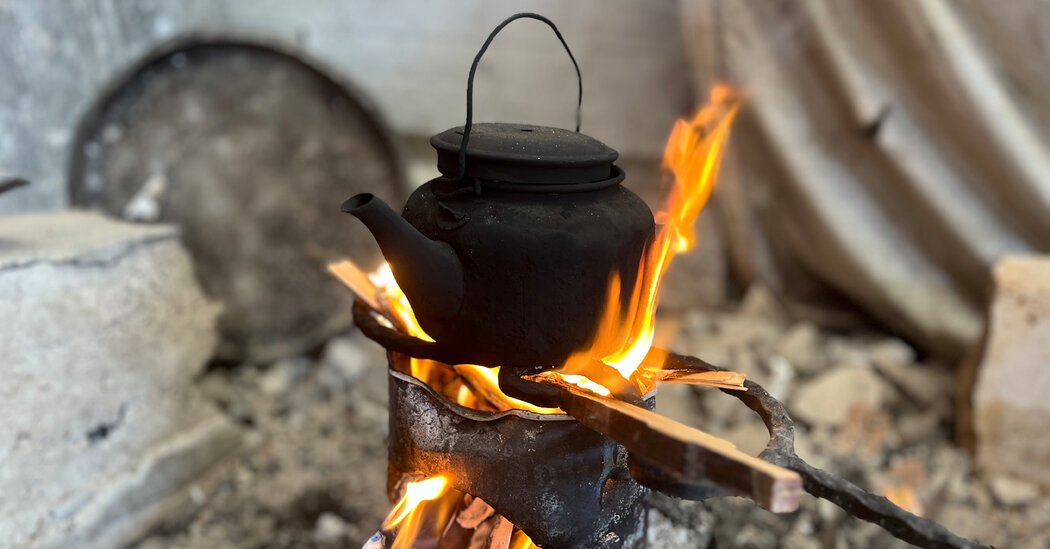
Since the war began, we ration everything: food, water, light. Now that the fuel is gone, we cook on a wood fire. Anything becomes kindling: broken pallets, torn blankets, old plastic sandals, empty cheese cartons, plastic jars. Now, when we make saj flatbread, we slide a teapot into the fire to use the heat from the flames twice. Most homes have the same setup: a big empty pickle or bean tin punched with air holes for a stove; a small bean can for a heater. All of us have burns on our hands and the black stain of smoke in our nails.
My nieces and nephews still go to makeshift schools. With pens, papers and pencils scarce — or when found, too expensive — they have to write in tight handwriting. My sister, who is a teacher, used to tell them to make their letters big and skip a line so the writing was clear. Now she can’t. The notebooks would get used up too quickly.
This war has altered everything in Gaza. It has changed not only our landscape but also our hearts, our minds and our souls. I sometimes look at people’s faces; they are yellow, pale and exhausted.
The war is insane — madness that seeps into the mind, into the body, into dreams. Sometimes I feel my thoughts unravel. I cannot fully grasp what is happening. I cannot imagine what will come next, or how it will come. Will I survive another night? Will I be alive to see the war’s final moment, if such a moment ever comes? We’ve seen countless plans. Many talks start, then fall apart just as quickly. I will believe in a cease-fire only when it passes through our door frame — when the drones go quiet, when the Israeli airstrikes stop.
For two years the Israeli war machine has continued its assault on the Gaza Strip. It rains destruction from the air and rolls destruction toward us on the ground. It even sends destruction from the sea. Nearly a quarter of a million people have been killed or injured, and countless more are dead under the rubble. Entire neighborhoods have vanished. So many homes, schools, hospitals, mosques, markets — the places that made up the daily rhythm of life in Gaza — are now rubble. The rhythm of our lives is now destruction, airstrikes, forced displacement, more airstrikes, people killed and then returning to ruins.
A friend who knows I speak with people outside Gaza asked me, “Do people outside know these details?” Because the details are how we measure our days.
